
How AI features are fundamentally changing intranets
Throughout the lifecycle of our Intranet and EX Platform review report I have demos from vendors so I can then update our assessments. In previous years this would often be a collection of small-scale amendments, such as introducing new homepage widgets or adding a new graph to analytics. But in recent weeks I’ve seen updates that fundamentally change the ways some of these platforms work.
An overview of changes
Generating content and supporting search with AI answers is fairly commonplace now, although the range and quality of functionality still vary. However, there are three big shifts that are having a significant impact on product architecture:
- AI interfaces are replacing menus
- Homepages are being dynamically personalised
- AI features have moved to the back-end to help with content creation and intranet admin
‘Assistant’ AI interfaces
AI agents / assistants allow people to complete tasks or search for information using natural language, usually within a chat interface. While integrations of business systems into widgets, or menus of links with single sign on are still supported (for the moment), the AI assistant approach is becoming more common for task completion. The same is true for search; the traditional search box and results page with refiners are still present, but often the generated answers will open more information in the assistant and / or the search screen will suggest further questions that open in the assistant.
In some cases, an AI assistant will act as a full AI agent by completing workflows without prompting, supervision or interaction. While in other examples it will ask the employee to verify choices or next steps before completing a task. This seems to largely be a choice to influence the employee experience and leave some control in their hands, rather than a reflection of the underlying AI’s abilities.
As a next step, we’re now seeing the de-prioritisation of “effort heavy” interface options by vendors, such as top-level navigation, read-only integrations, business application links, and search boxes. In some cases these are being removed entirely, or hidden behind burger menus or similar, so that the assistant approach dominates. This risks removing the choice of how individuals interact with a platform, which may cause frustration for some while improving the experience for others.
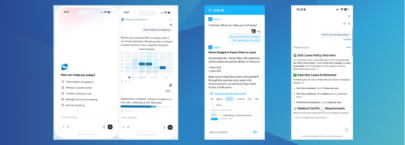
AI assistants in Appspace, Sociabble and Workvivo respectively show the range of potential on offer from these tools.
Dynamically personalised homepages
We’ve also started to see entire homepages adapt to reflect “what matters most” to an individual based on the behaviours they’ve exhibited. For years some platforms have been delivering news to people based on when’s been best for the individual, rather than publishing to everyone at the same time. More ambitious intranet designs have also tried to hide or show widgets based on audience targeting, but ‘dynamic personalisation’ driven by AI is a step beyond that. For example, if you interact with a feed of social posts that widget could become larger and move up the page so that’s easier for you to reach. Organisations may feel uncomfortable with removing some level of control over the homepage, but for those who struggle with intranet management this may improve overall standards.
Administrative AI
AI tools for administrators have been less common than those for employees, but it’s great to see functionality starting to emerge here now. For example, using a chat interface so admins can explore stats and build their own analytics dashboards is great (although I still maintain an improved and consistent baseline would be helpful across most products).
Similarly, AI can help identify old, stale, duplicate, missing and / or expired content and recommend improvements. These governance aids are highly valuable for admins, as well as the overall success of the intranet where AI relies on high governance standards, and so it would be good to see this functionality introduced to more platforms.
The significant development within administrative AI is the use of prompts to generate materials, such as creating content, entire spaces, and / or individual widgets (including those with integrations).
Firstly, generating content from a document is a valuable enhancement that’s taken a lot longer to develop than initial generative AI. Many organisations are likely to go through rigorous internal processes to sign off standard operating procedures, policies, and similar, likely with defined templates that can’t be changed for legislative reasons. The quick conversion from PDF to intranet page will help admins a great deal here. Agents for answering questions, and AI generated audio or written summaries of pages will support with reaching employees with information.
Another new addition is using written or voice prompts to generate widgets or other integrations. This certainly simplifies things for admins but still needs technical knowledge for testing and checking. As with many of these settings, there will also need to be careful controls in place to restrict who has the power to create new widgets etc.
More significantly still, administrative AI can be used to create collections of pages, sections and navigation, and even homepage design. This is done via prompts still, with the AI agents stepping through the process to create initial drafts that admins edit as wanted. The result might be a simple framework for people to build from, but I’ve also seen sophisticated results that almost look immediately ready to publish.
Unily was among the first to announce this functionality in October 2025 and it took more than six months for it to start to emerge. Other vendors are now developing similar functionality and I predict we’ll see more follow.
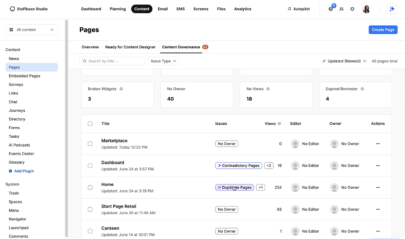
Staffbase includes AI features in admin areas, including this helpful governance dashboard and associated activities.
My thoughts
The speed and scale of change in the past year has been significant among those vendors who are heavily embracing AI. As a result a new era of user interface is upon us in the world of intranets.
Assistant / chat interfaces are exciting developments for the industry and there are a number of benefits they will bring to employee productivity. The value of intranets is increasing again as a result, as their agnostic nature means they can deliver a digital workplace front door experience now more than ever. Administrative AI too can let admins focus on enhancements and reduce some of the burden of time-consuming tasks.
From my experience however, many organisations want a degree of manual control over what is presented to employees and even content creation itself. Similarly, not every employee will want to ask the assistant for the most recent news, they may want to browse the latest before they head into a meeting. Jenks Miller makes a good point about an over-reliance on chat interfaces. They are best when the user is unsure what they want or if something is working as expected. If they are very clear about the workflow then a well-designed GUI remains the better options, as conversation is more demanding than clicking.
Writing this at a time of drought in South East England, the environmental impact of always-on AI can’t be underestimated too. I’d caution against removing flexibility and choice from organisations and employees.
Overall, these are exciting developments and the benefits seem to outweigh the concerns. Good practice across an organisation remains vital though, particularly ensuring that employee’s critical thinking and editing skills are not lost.
Read more about latest technology developments in our review report (free download).
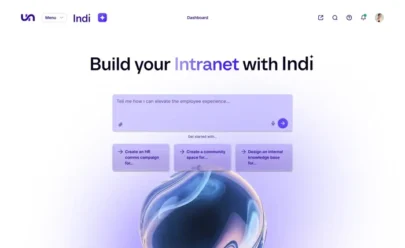
Indi is the back-end AI tool in Unily that helps admins create and maintain content.